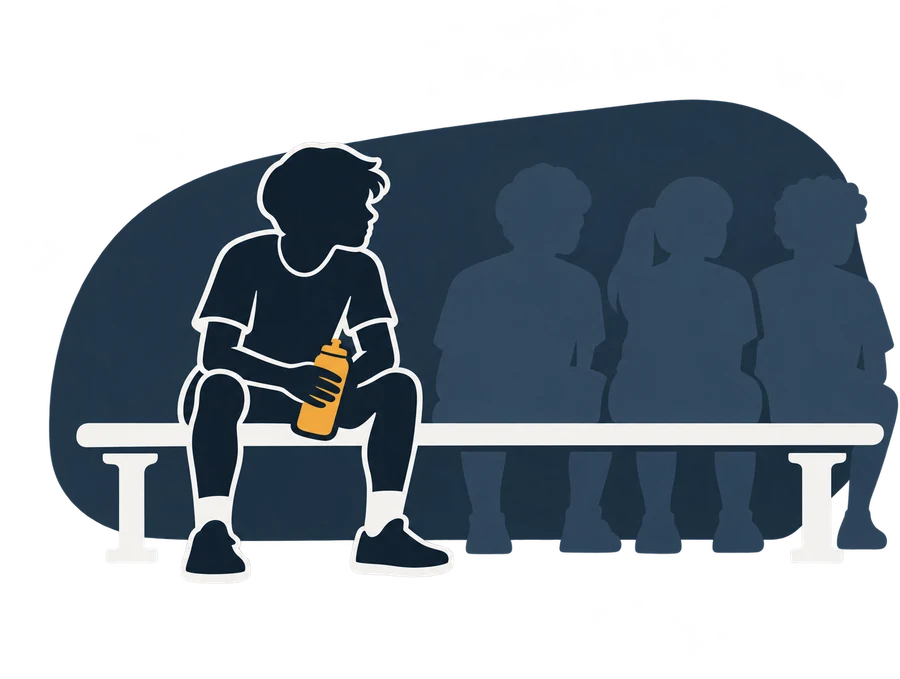
Your kid isn’t getting playing time. What do you say?
Your son has been at every practice. It’s the third game of the tournament, and he hasn’t gotten in all weekend. You’re in the bleachers watching him sit, and part of you wants to fix his playing time before he even gets in the car.
His playing time isn’t yours to fix tonight. His say in his own season is yours to protect.
Your first reaction
What you’ll want to say
The words that come first on a night like this, why they come so easily, and why they tend to miss.
Both are on his side. Both also decide what his spot on the team means, and what to do about it, before he’s said what he thinks.
Your own historyDid you ever sit the bench? Did you want someone to step in, or to let you handle it?
The idea
What’s really going on
The one idea that explains tonight, in plain words.
Why he’s sitting is a question for another day
Kids sit for lots of reasons. Someone ahead of him is better right now. He hasn’t shown enough in practice yet. His position is deep. Or the coach sees it differently than you do. Some of those are fair and some aren’t, and you won’t sort out which on the drive home.
What tonight can affect is how he feels about his place on the team, which is what keeps kids in a sport over time. Three things help:
The reasons he’s sitting are worth working out later, and mostly between him and his coach. Tonight, let him decide what it means.
Based on: self-determination theory
The ride home
In the car
What to do, in the order it comes up.
If you’re angrier than he is, give it a few quiet minutes of driving before you say anything about the coach.
If not, let it be. If he wants to talk:
What you might hear
That’s how it feels tonight, and it’s worth hearing out. Another day, you can ask what the coach has told him about his role.
Talk like this can come before effort slips. Ask what he’d want to get out of practice this week, whatever the lineup says.
That’s a good question, and the coach is the one who can answer it. Ask if he wants help thinking through how to ask.
Then keep it going. Say back what you heard, in their words, or ask about one thing they mentioned, in a way that leaves the answer to them: “Tell me about practice this week.” The urge to fix it, or to talk them out of how they feel, is your cue to do one of these instead.
His to decide: what to do about it. When he’s had his say, ask, “What do you want to do about it?” Talking to Coach is one option, and what to ask is his call too. If he wants help planning it, he can tell you.
Practice
Try it
A rep before the real thing. Pick what you’d most likely say, and you’ll see how it tends to land with your kid, from shutting them down to opening them up.
Third game of the tournament, and your son hasn’t gotten in. In the car he says, “This isn’t fair. Coach never plays me.” What do you say?
How this tends to land with your kid
Practice
Then what?
This is where most parents slip back into old habits. Pick what you’d say next.
You ask, “Do you think you should be getting more playing time?” He says, “Yeah. I’m better than half the guys out there.” What do you say next?
How this tends to land with your kid
His playing time isn’t yours to fix tonight. His say in his own season is yours to protect.
Practice this one with your own kid
Practice every ride home. The full version, $149 once:
- Unlimited practice rides, any night, with your own kid’s details
- More than a dozen common nights for your kid’s sport, or describe your own
- Full notes on every line you try, not just the highlights
- Three short lessons: what to notice at the game, how to ask in the car, and how to leave what’s next to them
- Help that steps back as you get better, so you need it less
- A free second seat for whoever else drives your kid home
“I was genuinely so impressed (and shocked!) at how it adapted the examples and language based on the specific sport I selected.”
Not helping after 30 days? Full refund, no questions asked.
See the full version